
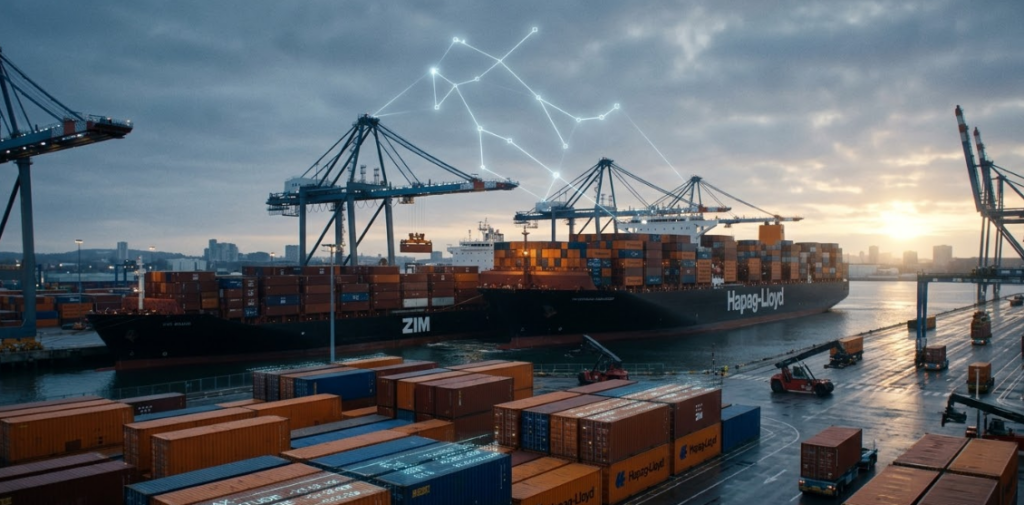
ZIM-Hapag Merger 2026: The Capacity Trap for Mid-Market Shippers
The ZIM-Hapag merger 2026 is not merely a corporate consolidation; it is a structural redesign of the Transpacific and Atlantic trade lanes. In early 2026, Hapag-Lloyd finalized its acquisition of ZIM Integrated Shipping Services. For mid-market shippers, the independent "wild card" of the ocean is being absorbed into the rigid architecture of the Gemini Cooperation.
Historically, ZIM operated as a high-agility, asset-light carrier that thrived by offering niche, premium services outside the massive vessel-sharing agreements (VSAs). With the completion of the ZIM-Hapag merger 2026, that independent capacity is effectively being "industrialized." The strategic focus is shifting from point-to-point agility to the hub-and-spoke efficiency of the Hapag-Maersk alliance.
ZIM-Hapag Merger 2026: Why Hub-and-Spoke Is a Risk
Central to this transition is the integration of ZIM’s fleet into the Gemini Cooperation. This alliance, targeting 90% schedule reliability, relies on a "controlled hub" model. Instead of direct port calls that mid-market shippers use to minimize drayage and lead times, cargo will increasingly flow through major transshipment hubs like Tanjung Pelepas and Algeciras.
The Transpacific Leverage Shift
By absorbing ZIM, Hapag-Lloyd jumps from the 6th largest to the 3rd largest carrier on the Transpacific trade. This consolidation grants the "Big 5" unprecedented control over contract terms. Shippers who previously used ZIM as a benchmark to negotiate against MSC or COSCO now find themselves with one less seat at the table. In a market already facing structural overcapacity, the ZIM-Hapag merger 2026 allows carriers to manage supply through coordinated "blank sailings" more effectively than ever before.
Don't be fooled by promises of "90% reliability." In a hub-and-spoke model, a single labor strike at a controlled hub terminal becomes a total supply chain freeze. At HMA Logic, we assume that consolidation equals fragility. The ZIM-Hapag merger 2026 confirms that shippers must maintain at least 20% spot-market agility with non-alliance carriers to hedge against the "Gemini Bottleneck."
The "New ZIM" Carve-Out: 16 Vessels and a Brand
To satisfy regulatory requirements, the merger includes a strategic carve-out. A new Israeli entity, colloquially dubbed "New ZIM," will operate 16 modern vessels focusing on strategic lanes into Israel and specific Mediterranean routes.
However, for the global mid-market shipper, "New ZIM" is a shadow of the original carrier's reach. While Hapag-Lloyd provides support, the disruptive pricing models once offered by ZIM are disappearing. Shippers must now treat "New ZIM" as a feeder-plus service rather than a global Tier-1 alternative under the new ZIM-Hapag merger 2026 framework.
| Operational Metric | Legacy ZIM (Pre-2026) | ZIM-Hapag Merger (Post-2026) |
|---|---|---|
| Network Model | Point-to-Point / Niche Fast-Gate | Hub-and-Spoke / Gemini Alliance |
| Transpacific Rank | Top 10 Independent | Top 3 (Combined with Hapag) |
| Vessel Strategy | Asset-Light (High Charter) | Asset-Heavy (Mega-Vessel) |
| Negotiation Power | High (Disruptive Pricing) | Low (Standardized Terms) |
Navigating the 2026 Contract Season
As we enter the 2026 contract cycle, the market is currently a "buyer's market" due to massive vessel overcapacity. However, the ZIM-Hapag merger 2026 creates a "floor" for rates that might otherwise have collapsed further. Carriers are already using the "Gemini transition" as a justification for revised surcharge structures and bunker adjustment factors (BAF).
Actionable Execution Steps for Shippers:
- Audit Your Port Pairs: Identify which of your current ZIM direct calls are being transitioned to feeder/shuttle services. Factor in an additional 3-5 days of lead time.
- Diversify Alliance Exposure: Do not place 100% of your volume within the Gemini Cooperation (Maersk/Hapag). Balance your portfolio with Ocean Alliance (COSCO/CMA CGM).
- Benchmark Data-First: Ensure your "standardized" Hapag contract isn't 15% above the market average during the integration phase.
HMA Logic: Protecting Your Margin
At HMA Logic, our philosophy is simple: **Capacity is only real when the container is gated in.** We don't rely on the theoretical "service explorers" provided by alliances. We look at the actual vessel queue and the labor stability at the hubs.
The ZIM-Hapag merger 2026 is a signal that the era of the independent niche carrier is ending. Shippers must evolve from "procurement" to "operations." It is no longer about who has the cheapest rate; it is about who has the most resilient route when the consolidation trap closes.