
Navigating Port Strikes and Delays: A 2026 Resilience Guide
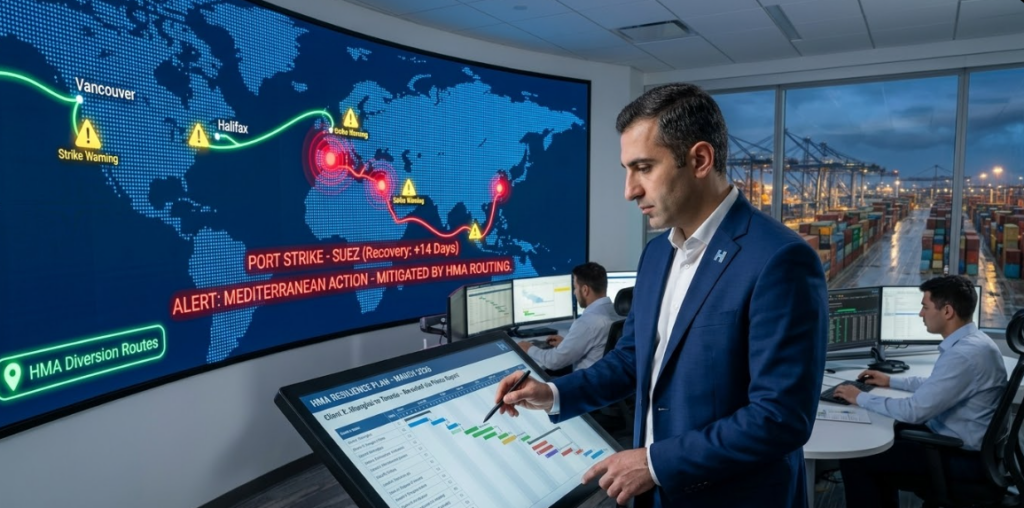
In the first quarter of 2026, the global logistics community has been reminded that a 'one-day stoppage' creates a multi-week recovery curve. Between the coordinated dockworker actions across 21 Mediterranean ports and the sudden instability in the Strait of Hormuz, the 'Just-in-Time' model is under extreme stress. At HMA Inc., we believe resilience isn't just a defensive posture—it is a competitive advantage.
1. The Anchorage Queue: Your Leading Indicator
The first sign of systemic failure isn't a headline; it is the Anchorage Queue. In March 2026, we are monitoring anchorage delays in Singapore and Colombo that are reflecting 2-4 days of congestion before official berth delays are even made public. By tracking the delta between 'Planned ETA' and 'Actual Arrival,' our team at HMA Inc. can trigger a pivot before your cargo is 'rolled' or trapped.
2. Tactical Rerouting: Beyond the Panic Button
When a major gateway hits 85% yard utilization, it is time to execute a precision pivot. For our Canadian importers, this often means diverting from a congested Vancouver port to Prince Rupert, or even exploring 'Sea-Rail' combinations through US East Coast ports to reach Ontario and Quebec.
HMA Resilience Tactic: The 'Multi-Node' Hedge
Don't rely on a single carrier or alliance. In 2026, we ensure that no more than 40% of a client's volume is tied to a single port-pair. This allows us to shift capacity dynamically to air freight services or alternative ocean freight forwarding lanes without halting the entire supply chain.
3. Managing the 'Recovery Tail'
A port strike might end on a Friday, but terminal productivity doesn't rebound instantly. The recovery often starts with yard re-marshalling and equipment repositioning. During this phase, Destination Terminal Handling Charges (DTHC) and demurrage risks are at their peak. At HMA Inc., we leverage real-time visibility to ensure drayage teams are ready the moment a container is 'Ground' to avoid these 'hidden' costs.
4. Pre-Clearance: The Final 72-Hour Rule
In a disrupted market, every hour counts. We mandate that all customs clearance documentation be finalized 72 hours before vessel arrival. This 'Pre-Arrival Review' is essential for bypassing the digital bottlenecks created by the 2026 CARM requirements during port congestion events.
Is Your Supply Chain Crisis-Proof?
Don't wait for your cargo to be 'trapped' at anchor. Let HMA Inc. audit your 2026 resilience plan today.
Request a Resilience Audit