
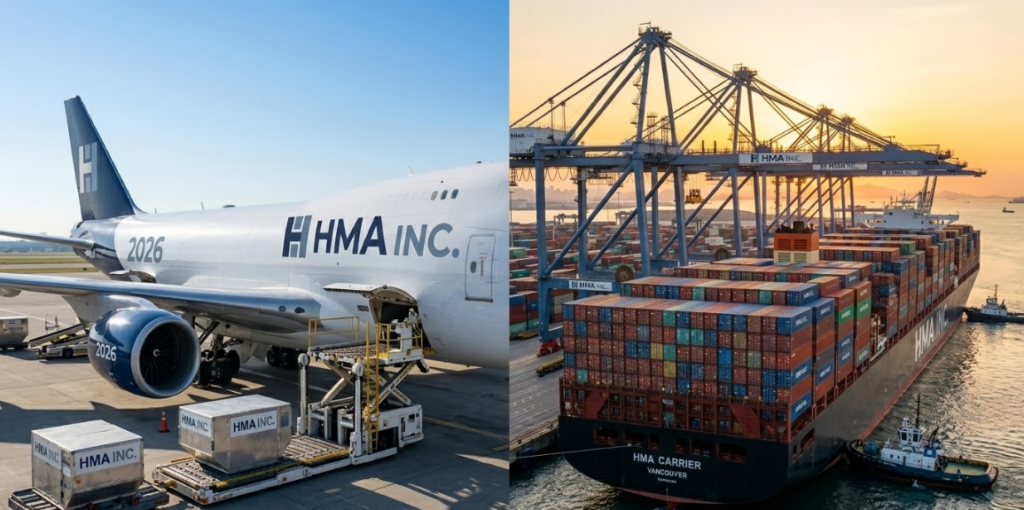
Air Freight vs. Ocean Freight: The Tipping Point
In the current logistics landscape of March 2026, the gap between air and ocean has never been more defined. As CEO of HMA Inc., I often tell our clients that the choice isn't just about 'fast vs. cheap.' It is about inventory velocity. With ocean spot rates hitting record lows due to vessel overcapacity, and air cargo rates remaining high due to the 'AI-boom' and e-commerce surges, your decision in 2026 requires a deeper look at your total landed cost.
1. The Speed Gap: Days vs. Weeks
The most obvious differentiator is transit time. Air freight typically moves door-to-door in 3 to 8 days. In contrast, ocean freight forwarding from Asia to North America is currently averaging 22 to 35 days, depending on port congestion in hubs like Vancouver or Savannah.
However, speed is a strategic lever. If you are launching a new product line or restocking a 'hero item' that is sold out, the premium for air is actually an investment in missed revenue prevention. If you are shipping stable, high-volume inventory, the ocean is your best friend for margin preservation.
2. Reliability and the Red Sea Factor
In 2026, ocean reliability is still recovering from structural shifts in global waterways. Rerouting around the Cape of Good Hope has added 10-14 days to many schedules. Meanwhile, air freight services operate on fixed, high-frequency schedules. While a container might be 'rolled' to the next week's vessel, air cargo usually moves within 24 hours of arrival at the terminal.
3. Environmental Impact and ESG Goals
For many of our corporate clients, the 'Green Factor' is now a deciding variable. Ocean freight produces roughly 47 times less CO2 than air freight per ton-mile. If your company has strict 2030 Net-Zero targets, moving as much cargo as possible to the water is the most effective way to slash your Scope 3 emissions. At HMA Inc., we provide carbon-footprint reporting for both modes to help you hit those benchmarks.
4. The Hybrid Solution: Sea-Air
Why choose one? We are increasingly moving clients to a Hybrid Sea-Air model. We ship your goods by sea to a mid-point hub (like Dubai or Singapore) and then fly them the rest of the way. This cut costs by 50% compared to pure air and cuts time by 50% compared to pure sea. It is the 'Best of Both Worlds' strategy for 2026.
Need a Mode Comparison?
Don't guess your logistics costs. Let HMA Inc. run a comparative analysis for your next shipment.
Compare Freight Quotes Now